
how to calculate mao for real estate deals
How to Calculate MAO for Real Estate Deals in South Jersey (2026 Guide)
Learn how South Jersey investors calculate MAO (Maximum Allowable Offer) to avoid overpaying, screen deals faster, and protect profit using a repeatable real estate deal analyzer framework.

What Is MAO in Real Estate?
MAO (Maximum Allowable Offer) is the highest price a real estate investor can pay for a property while still accounting for rehab costs, holding expenses, selling fees, and a required profit margin. It defines the absolute top number an investor should offer — not a target price.
In simple terms, MAO answers one critical investment question: “What is the most I can pay for this property and still have a deal that works?” This makes MAO a foundational metric in any professional real estate deal analyzer.
When the seller’s asking price exceeds your Maximum Allowable Offer, the deal should be treated as a WATCH (pending renegotiation) or a firm PASS. Chasing deals above MAO is one of the fastest ways investors lose money.

Why MAO Matters for South Jersey Investors
South Jersey real estate markets vary widely by town, property condition, price point, and buyer demand. What works in Camden or Gloucester County may not work in Burlington or Cumberland. This is why using a disciplined Maximum Allowable Offer (MAO) is critical for investors operating locally.
MAO helps investors apply the same rules to every deal when analyzing:
- Fix-and-flip investment properties
- Wholesale and assignment opportunities
- Value-add and light rehab deals
- Off-market and distressed properties
- Foreclosures, pre-foreclosures, and auction leads
In a professional real estate deal analyzer, MAO is always the first step. It prevents overpaying, filters out weak deals early, and
The MAO Formula (Simple & Practical)
The Maximum Allowable Offer (MAO) formula helps investors calculate the highest price they can pay for a property while still protecting profit and downside risk.
A complete MAO formula looks like this:
MAO = ARV − Repair Costs − Holding Costs − Selling Costs − Desired Profit
This approach works well when using a real estate deal analyzer because it forces you to account for every major expense — not just purchase price and rehab.
Some investors use a simplified shortcut formula:
MAO = (ARV × 70%) − Repairs
While the 70% rule can be useful for quick screening, it should always be adjusted based on deal size, financing method, timeline, and local South Jersey market conditions.
How to Calculate Maximum Allowable Offer (MAO) Step by Step
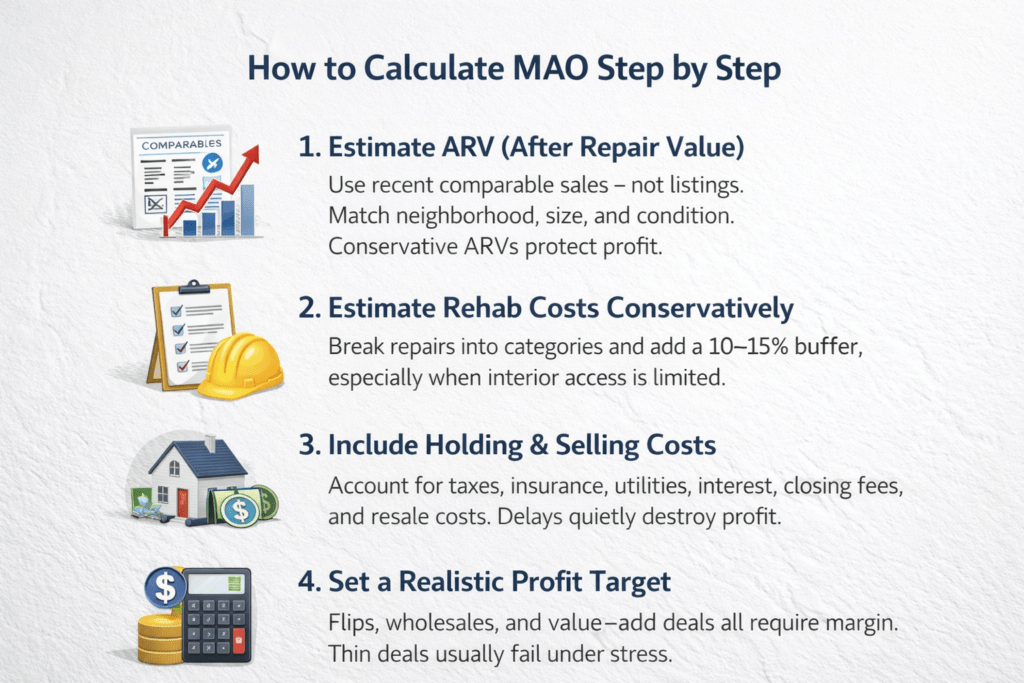
Use this step-by-step process to calculate MAO (Maximum Allowable Offer) with conservative assumptions. This is the same order most investors follow in a real estate deal analyzer so missed costs don’t destroy the deal.
1. Estimate ARV (After Repair Value)
Base ARV on recent sold comps (not active listings). Match the same neighborhood, similar square footage, bed/bath count, and a comparable after-repair condition. When in doubt, choose the lower ARV to protect profit.
2. Estimate Rehab Costs Conservatively
Break rehab into categories (roof, HVAC, kitchens/baths, flooring, paint, electrical, plumbing) and add a 10–15% contingency buffer—especially if interior access is limited or photos are incomplete. Underestimating repairs is one of the fastest ways to overpay.
3. Include Holding & Selling Costs
Add carrying costs like taxes, insurance, utilities, financing interest, and HOA (if applicable), plus selling costs like agent commissions, closing fees, and transfer taxes. Even a 30–60 day delay can quietly wipe out profit if these numbers aren’t included.
4. Set a Realistic Profit Target
Choose a profit target that matches your strategy (flip, wholesale assignment, or value-add). Thin deals usually fail under stress—so build in margin for price cuts, rehab surprises, and slower-than-expected resale timelines.
Pro tip: Run your MAO twice—(1) realistic and (2) stress-tested (+15% rehab, +1–2 months holding, -3% ARV). If it only works in the best-case scenario, it’s usually a WATCH or PASS.
Example Maximum Allowable Offer (MAO) Calculation
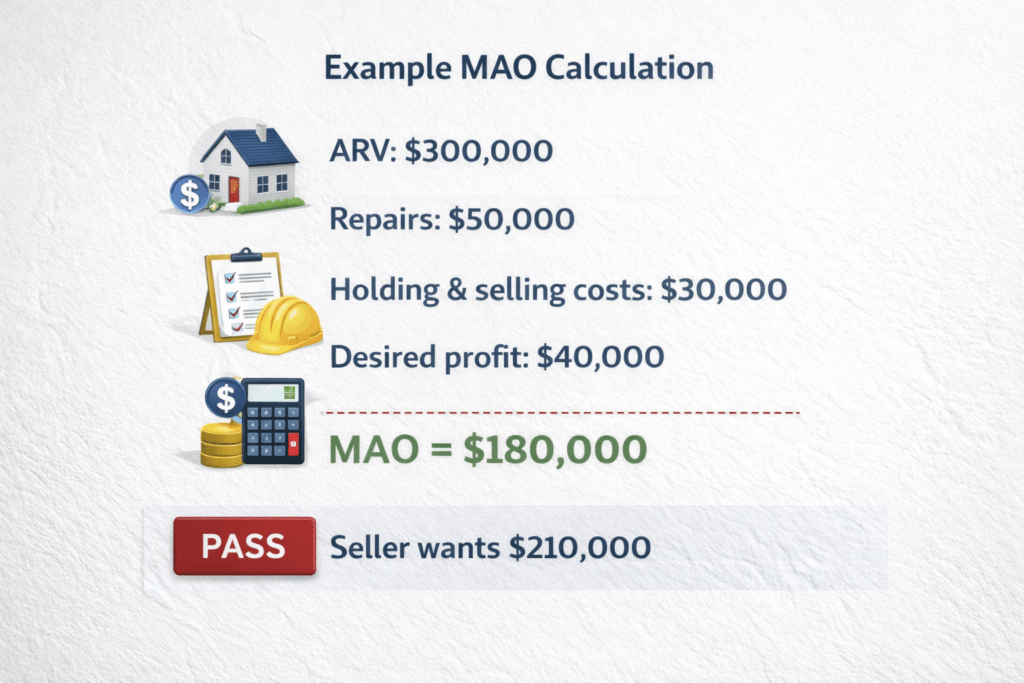
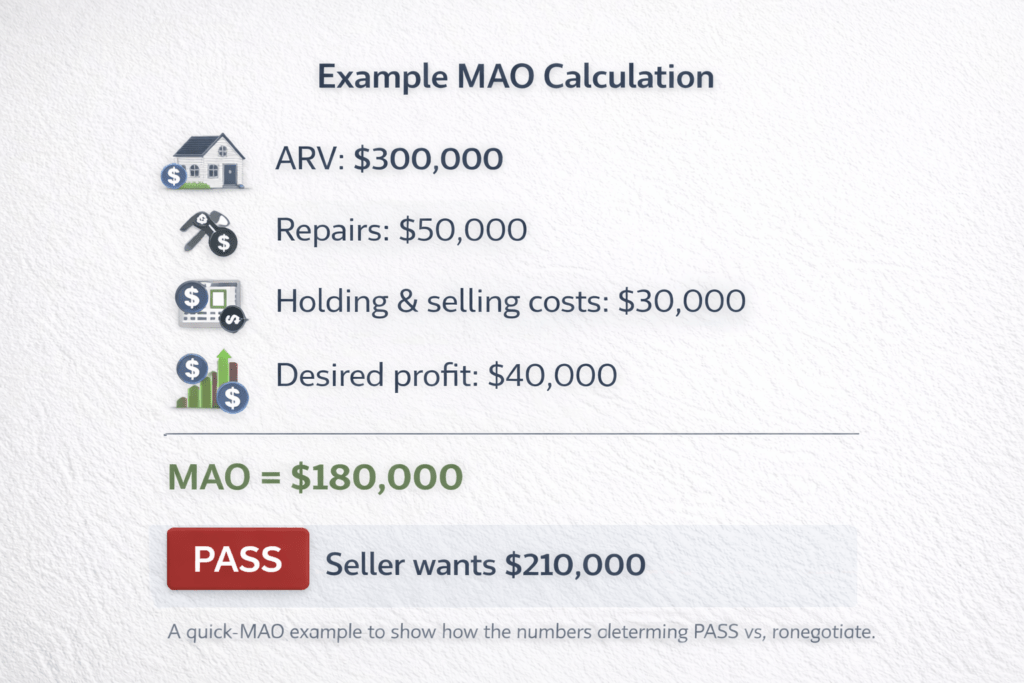
This example shows how a Maximum Allowable Offer (MAO) is calculated using a conservative, investor-grade real estate deal analyzer. These are realistic numbers commonly seen in South Jersey markets.
- After Repair Value (ARV): $300,000
- Estimated Repairs: $50,000
- Holding & Selling Costs: $30,000
- Target Investor Profit: $40,000
Maximum Allowable Offer (MAO) = $180,000
In this scenario, if the seller is asking $210,000, the deal does not meet the MAO threshold. A disciplined investor would either renegotiate or correctly mark this deal as a PASS.
This is exactly how experienced investors use MAO to protect capital, avoid emotional decisions, and focus only on deals that truly work.

Use a MAO Calculator to Analyze Deals Faster (Recommended)
Calculating Maximum Allowable Offer (MAO) by hand often leads to missed costs and optimistic assumptions. That’s why most experienced investors rely on a real estate deal analyzer to run MAO calculations consistently and objectively.
A structured MAO calculator helps you:
- Account for rehab, holding, and selling costs
- Stress test profit margins before making offers
- Reach faster PASS / WATCH / MOVE decisions
Common Maximum Allowable Offer (MAO) Mistakes to Avoid
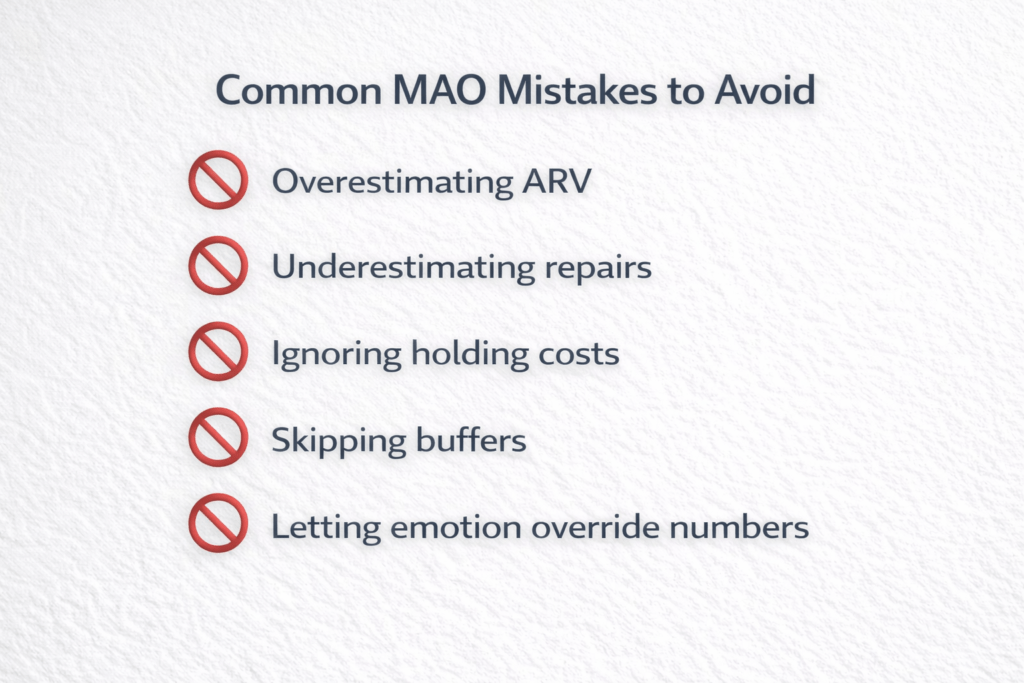
Even experienced investors lose money when they ignore Maximum Allowable Offer (MAO) discipline. These mistakes usually come from rushing numbers or skipping steps in a proper real estate deal analyzer workflow.
- Overestimating ARV: Using listings instead of sold comps inflates value.
- Underestimating repairs: Cosmetic-only budgets miss major systems.
- Ignoring holding costs: Time delays quietly erode profit.
- Skipping buffers: No contingency = no protection.
- Letting emotion override numbers: A deal that “almost works” usually fails.
A disciplined MAO process helps investors pass faster on weak deals and focus only on opportunities that survive conservative analysis.

Final Thoughts: Maximum Allowable Offer (MAO) Is the Foundation of Deal Analysis
Maximum Allowable Offer (MAO) is not about making offers — it’s about knowing when not to. Investors who calculate MAO first using a real estate deal analyzer protect their capital, time, and decision-making process.
Whether you’re flipping houses, wholesaling contracts, or sourcing off-market opportunities, MAO creates a clear PASS / WATCH / MOVE decision before emotion enters the deal.
In competitive South Jersey markets, investors who
When to PASS Using Maximum Allowable Offer (MAO)
One of the most overlooked advantages of calculating a Maximum Allowable Offer (MAO) is knowing exactly when to walk away from a deal. Experienced investors understand that protecting capital is just as important as finding opportunities.
A disciplined real estate deal analyzer removes emotion from the process by setting a clear ceiling price based on numbers — not pressure, competition, or seller urgency.
If a seller’s asking price is significantly higher than your MAO and there is little room for renegotiation, the correct decision is often to PASS. Overpaying at the acquisition stage eliminates margin and magnifies risk, especially in competitive South Jersey submarkets.
Investors who consistently respect their Maximum Allowable Offer analyze more deals, avoid costly mistakes, and focus only on opportunities that meet strict profit and risk criteria. In the long run, knowing when not to buy is what separates sustainable investors from speculative ones.